Composite vs Ceramic Bathroom Fixtures: What Should B2B Buyers Consider?
September 3, 2026


Author: Paulina Grodziska
Specialist in B2B sanitary ware manufacturing, sourcing and marketing, with a focus on turning product capabilities into commercial growth.
For brands, retailers, distributors and project buyers, choosing between ceramic and composite bathroom fixtures is not simply a question of which material is “better”. Both can work very well, but they offer different advantages in terms of design, durability, repairability, comfort and product positioning.
Ceramic is familiar, widely used and proven across many bathroom categories. Composite materials can offer greater flexibility in shape, colour and finish, together with practical benefits that may help a product stand out in a more design-led or premium range.
The key is to understand how these materials differ and which characteristics matter most for your business model and target customer.
In this article, we compare ceramic and composite bathroom fixtures from a B2B perspective and explain what buyers should consider before choosing one over the other.
01. First, understand what “composite” actually means
Before comparing ceramic and composite bathroom fixtures, it is worth clarifying the terminology. Ceramic products are made from mineral-based raw materials that are formed, fired at high temperatures and typically finished with a glazed surface. Composite fixtures are produced differently, usually by combining mineral fillers with resin and, depending on the system, adding a separate surface coating.
The important point for B2B buyers is that “composite” does not describe one single material. Different formulations can behave very differently in terms of weight, surface finish, durability and design possibilities.
For example, Marmorin’s MINERALICAST® combines powdered dolomitic marble with resin and a sanitary gelcoat coating. The company also uses MULTICAST®, an ultra-light composite developed for larger products, and MONOCAST®, a homogeneous solid-surface material.
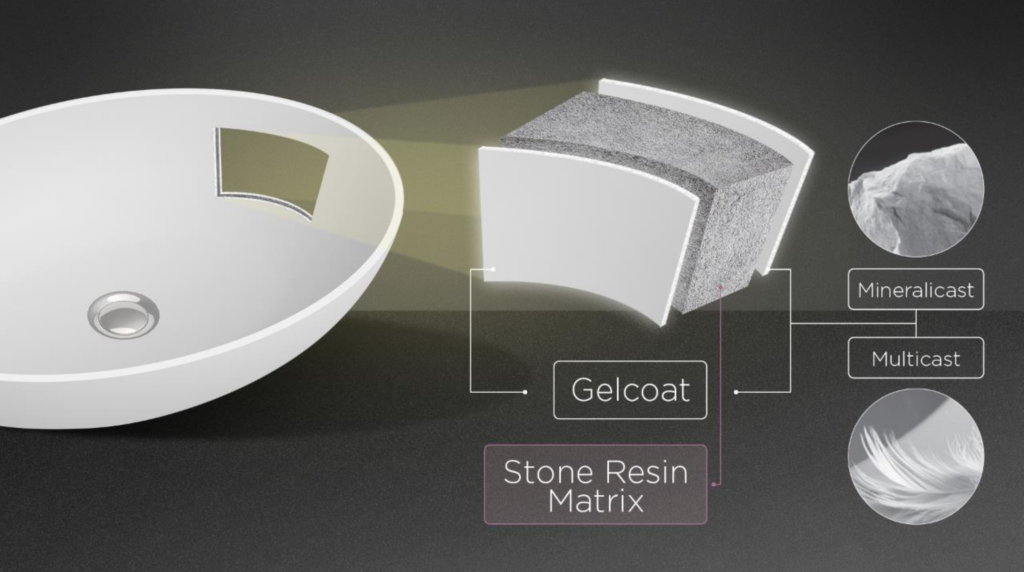
Understanding what a supplier actually means by “composite” should therefore come before comparing its benefits with ceramic.
02. Design freedom and surface finish
One of the clearest differences between ceramic and composite bathroom fixtures is the amount of design freedom they can offer.
Ceramic is an established material that can deliver excellent glazed surfaces and works very well for many standard bathroom forms. Composite materials, however, can give manufacturers more flexibility when developing unusual shapes, slimmer-looking profiles, larger formats or products intended to stand out visually.
They can also offer a wider range of colour and finish options. Marmorin, for example, works with glossy and matt finishes, a broad RAL colour range and multicolour designs. Strong colour depth and very smooth surface finishes are key characteristics of such products.
For B2B buyers, this matters because material choice can influence how distinctive the final collection feels. A retailer or brand looking for a familiar, broadly appealing range may be perfectly well served by ceramic. A business trying to create a more design-led or premium offer may find the flexibility of composites particularly valuable.
“For a B2B buyer, material choice is not only a technical decision. It also determines how much freedom you have to create a collection that customers immediately recognise as different from standard bathroom products.”
Agnieszka Maliszewska, Chief Sales Officer at Marmorin
03. Durability is not just about which material is “stronger”
When comparing ceramic and composite bathroom fixtures, durability should not be reduced to a simple question of which material is stronger. Both can perform very well, but they tend to respond differently to wear and damage.
Ceramic is hard, resistant to everyday use and capable of maintaining its appearance for many years. Its main limitation is brittleness. A strong impact can cause chipping or cracking, and significant damage is usually difficult to repair.
Selected composite materials can also offer high durability, but one of their practical advantages is that minor surface damage may be repairable rather than requiring complete product replacement. This can be particularly relevant in hotels, rental properties or large residential developments where replacing an installed fixture can be costly and disruptive.
B2B buyers should therefore look beyond broad durability claims and ask how the material has actually been tested. These tests should include chemical resistance, dry heat, thermal shock, impact, scratching, cleanability and other performance characteristics.
Tip: ask what happens when a product is damaged
Durability matters, but for a B2B buyer it is just as important to understand what happens when damage actually occurs. A product that can be repaired after a minor chip, scratch or surface defect may be much easier and less expensive to manage than one that needs to be removed and replaced completely.
This becomes particularly important in hotels, residential developments and other projects involving large numbers of bathrooms. Replacing an installed fixture can mean not only the cost of a new product, but also transport, installation work, potential downtime and coordination with contractors or maintenance teams. We look at what this means in practice for hotel projects in our guide to choosing washbasins for hotel bathrooms.
When comparing materials, ask the supplier not only how resistant the product is, but also which types of damage can be repaired, how repairs are carried out and when full replacement becomes necessary.
04. Comfort, acoustics and handling
Material choice also affects how a bathroom fixture feels in everyday use and how practical it is to handle during installation.
Selected composite materials, compared with many ceramic fixtures, can offer good heat retention, which may help bathwater stay warm for longer and make the product feel more comfortable in use. What’s more, composite bathroom fixtures such as bathtubs can have noise-absorbing properties, helping to reduce the hollow sound sometimes associated with lighter constructions.
Weight is another factor worth considering, especially with larger products. Traditional cast-stone composites can be relatively heavy, which may affect transport and installation. This is one reason Marmorin developed MULTICAST®: to reduce the weight of large washbasins and bathtubs while maintaining durability and surface performance.
For a B2B buyer, these characteristics can influence more than user comfort. They can also affect installation time, logistics, handling on site and the overall experience of the finished product. This is why material selection should take both end-user benefits and practical project requirements into account.

Not sure whether ceramic or composite is the right choice for your product range?
Get in touch with Angelika Jachimowicz, our Key Account Manager. She will discuss your product requirements and help you understand which material, finish and manufacturing approach may be the best fit for your brand or project.
05. Which material makes more sense for your product strategy?
The final decision should depend less on which material appears stronger on paper and more on what kind of product range you are trying to build.
Ceramic may be the better fit when familiarity, broad market acceptance and proven standard formats are the priority. It can work especially well for ranges aimed at customers who expect conventional bathroom products and do not require extensive customisation.
Composite materials become particularly interesting when differentiation matters more. Greater freedom in shape, colour and finish can help a brand create a more distinctive collection, while features such as repairability, heat retention or reduced weight in selected formulations may add practical selling points. B2B suppliers sometimes combine composite manufacturing with private label, OEM, ODM and custom product development, which shows how material choice can become part of a wider product strategy rather than a purely technical decision.
Neither material is automatically superior. The better choice is the one that best matches your target customer, price positioning, design ambitions and practical requirements.
Composite vs ceramic bathroom fixtures: quick comparison
By default there is no “better choice”. Ceramic remains a proven option for familiar, broadly appealing bathroom ranges, while composite materials can offer additional opportunities for differentiation, customisation and selected practical benefits.
|
Factor |
Composite |
Ceramic |
|---|---|---|
|
Design freedom |
Often high |
More limited by production process |
|
Colours and finishes |
Broad possibilities |
Strong glazed finish options |
|
Repairability |
Possible with some materials |
Usually limited after chips or cracks |
|
Heat retention |
Can be a strength |
Generally lower |
|
Weight |
Varies significantly by formulation |
Usually relatively predictable |
|
Market familiarity |
Less conventional |
Very well established |
|
Best suited to |
Design-led and differentiated ranges |
Familiar, broad-market ranges |
For B2B buyers, the right decision should therefore start with the intended customer and product positioning. Consider the design you want to achieve, the practical requirements of the finished product and which material gives your sales team the strongest proposition to take to market.